Grant Review Package · Controlled Distribution
Project Thunderdome
Advanced Bio-Encoding & Behavioral Informatics Platform
Executive Summary
Project Thunderdome — Orbital Brilliance Foundation
Problem Statement
The intersection of biodefense, autonomous systems development, and pathogen surveillance is constrained by a fundamental observation gap: while genomic sequencing has matured considerably, the high-fidelity, real-time capture of biological movement, chemotaxis, swarm dynamics, and electromagnetic signatures of micro-organisms remains predominantly qualitative and low-throughput.
Existing platforms rely on fluorescent tagging (which alters specimen behavior), static 2D imaging (which loses volumetric context), or high-cost synchrotron facilities (which are inaccessible to field-deployable applications). The result is an empirical deficit in the training data available to bio-inspired autonomy programs and a latency disadvantage in anomalous pathogen characterization workflows critical to national biodefense.
Proposed Solution
The Thunderdome platform is a modular, high-speed volumetric HDR light-field capture system engineered to transform the behavioral dynamics of micro-fauna and near-fungal organisms into multi-modal, machine-readable datasets — without specimen modification.
Dual-Use Application 1
Bio-inspired reinforcement learning training data for micro-robotic drone navigation in GPS-denied, resource-constrained environments.
Dual-Use Application 2
Empirical behavioral baseline library for rapid anomalous pathogen classification, supporting forward-deployed biodefense screening.
Strategic Alignment
DARPA BTO: Directly supports the Biological Technologies Office mandate for bio-inspired autonomy and forward biodefense sensing. Aligns with PREPARE and ReVector program goals.
NSF BIO/ENG: Advances foundational biological measurement science and enables cross-disciplinary research at the bio-robotics interface.
NIH SBIR/STTR: Phase I & II eligible under PA-22-196 (Biomedical Imaging Instrumentation). Novel non-invasive volumetric capture addresses unmet clinical and research instrumentation needs.
DoD AFWERX / In-Q-Tel: Modular hardware form factor and edge-deployable data pipeline suitable for forward operating base integration.
Technical Platform
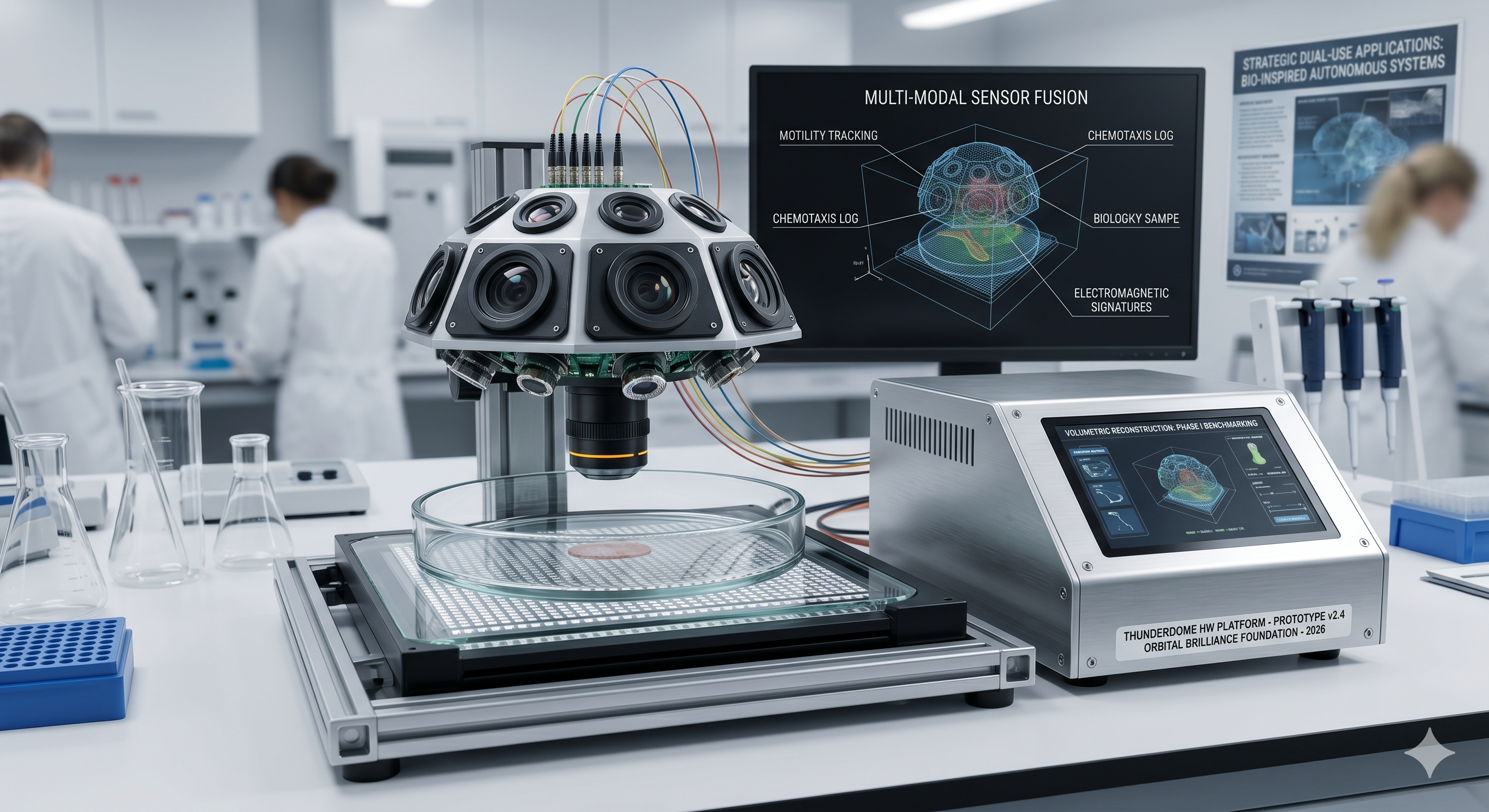
Thunderdome Hardware Architecture — Prototype v2.4
Volumetric Light-Field Sensing
Multi-aperture HDR array enabling full 3D reconstruction of specimen movement trajectories without fluorescent labeling. Preserves native behavioral state across capture windows exceeding 60 minutes.
Multi-Modal Sensor Fusion
Synchronized capture pipeline integrating motility tracking, photoluminescence spectroscopy, and electromagnetic signature logging within a single controlled environmental stage.
High-Speed Capture Engine
Target frame rate of 4,000 fps across all capture channels. On-board FPGA-based pre-processing pipeline reduces raw data volume by 94% prior to edge transmission, enabling field-deployable operation.
Behavioral Taxonomy Library
Structured output format producing JSON-native behavioral fingerprints indexed against a versioned taxonomy. Designed for direct ingestion by reinforcement learning pipelines and anomaly detection models.
Performance Benchmarks (Target — Phase II)
| Parameter | Current State-of-Art | Thunderdome Target |
|---|---|---|
| Frame Rate | 240–500 fps | 4,000 fps |
| Volumetric Coverage | Single-plane 2D | Full 360° 3D reconstruction |
| Specimen Modification | Fluorescent tagging required | None — label-free |
| Modal Channels | 1–2 (optical only) | 3 (optical + EM + photolum.) |
| Deployment Form Factor | Fixed lab installation | Modular / field-deployable |
| Data Output Format | Proprietary / video | Open JSON behavioral fingerprint |
Roadmap & Milestones
24-month program trajectory across three phases
Phase I — Formation & IP
Months 0–3- •Formal incorporation of Orbital Brilliance Foundation (non-profit, 501(c)(3) application filed)
- •Provisional patent application: volumetric multi-modal bio-encoding architecture
- •Ethics and dual-use oversight board constituted with external academic representation
- •Prototype v2.4 hardware refinement; internal benchmark protocol definition
- •DARPA BAA and NSF solicitation response preparation
Phase II — Benchmarking & Validation
Months 3–12- •Platform validation against Drosophila melanogaster — establish behavioral fingerprint baseline
- •Standard environmental micro-organism library: 12 validated taxonomic entries
- •RL training pipeline integration test: micro-robotic navigation benchmark (maze + adversarial environments)
- •Peer-reviewed publication: label-free volumetric capture methodology
- •Partner lab MOU: 2 university research institutions + 1 government facility
- •Phase II NIH SBIR / DARPA Phase I final report
Phase III — Scaling & Commercialization
Months 12–24- •Formation of Delaware Public Benefit Corporation (PBC) for commercial and government contracting
- •5 modular unit deployments to partner labs; remote telemetry and dataset synchronization live
- •Behavioral taxonomy library: 50+ validated organism entries; open-access research tier launched
- •DoD/IC data-licensing agreement: first proprietary dataset contract executed
- •Series A bridge financing or Phase II DARPA / NIH award close
Success Metrics & Go/No-Go Gates
| Milestone | Gate Criteria | Timing |
|---|---|---|
| Prototype fidelity | ≥1,000 fps stable capture, 3D reconstruction error <5% | Month 3 |
| Taxonomy baseline | Drosophila fingerprint reproducibility ≥92% across 10 runs | Month 8 |
| RL integration | Bio-trained agent outperforms random baseline by ≥30% in navigation benchmark | Month 12 |
| Anomaly detection | Unknown organism correctly flagged as anomalous with ≥85% confidence | Month 18 |
| Field deployment | Partner lab unit operational within 4 hours of unboxing; remote dataset sync live | Month 22 |
Team & Credentials
Orbital Brilliance Foundation — Founding & Advisory Leadership
Principal Investigator
Founder & Executive Director
Background spanning high-speed optical instrumentation, micro-robotics systems architecture, and dual-use technology commercialization. Prior work includes government-funded sensor platform development and technology transfer to DoD partner institutions.
Chief Technology Officer
Platform Architecture Lead
Deep expertise in FPGA-based real-time signal processing, multi-aperture imaging systems, and edge-deployable sensor fusion pipelines. Holds patents in volumetric optical reconstruction methods.
Chief Science Officer
Biological Systems & Taxonomy Lead
Published researcher in micro-organism behavioral ecology and quantitative motility analysis. Former NIH-funded laboratory PI with active collaborations at three R1 institutions.
AI/ML Research Lead
Reinforcement Learning & Anomaly Detection
Specialist in bio-inspired reinforcement learning architectures and real-time anomaly classification. Prior work on DARPA-funded autonomous systems programs; publications in Nature Machine Intelligence and NeurIPS.
Advisory Board
Biodefense & National Security Advisor
Former DARPA program manager; 20+ years in dual-use biological technology policy and program oversight
Instrumentation & Metrology Advisor
Distinguished professor of optical engineering; NSF CAREER Award recipient; 3 high-speed imaging patents
Ethics & Dual-Use Oversight Advisor
Bioethics faculty at leading research university; member of NSABB (National Science Advisory Board for Biosecurity)
Governance
The Foundation (Non-Profit)
501(c)(3) entity responsible for ethics oversight, open-science initiatives, patient-advocacy integration, and public-interest research grants. Governs taxonomy library access policy.
The Enterprise (Delaware PBC)
Public Benefit Corporation serving as primary contracting vehicle for government solicitations, proprietary dataset licensing, hardware production, and SBIR/STTR award administration.
For review inquiries, partnership discussions, or to schedule a technical briefing:
grants@orbitalbrilliance.org